January 2016
Attorney "Announcement E-mails" Not Protected Under Anti-SLAPP Statute
Another cautionary tale concerning attorney letters.
It has long been the case that attorney letters are protected under the anti-SLAPP statutes and Civil Code section 47, if they relate to potential or pending litigation. But the case of WHGC PLC v. John D. van Loben Sels et al., decided earlier this month, added yet another wrinkle to the analysis.
In this case, two attorneys were leaving the law firm WHGC, and moving to the firm of Fish & Tsang. They sent out emailed announcements to current and former WHGC clients, which included information about the new firm, and which stated the clients “have the right to choose the law firm and the attorneys with whom [they] work,” adding that the attorneys would support “any necessary transition”.
WHGC didn't appreciate this communication to its clients, and sued, claiming this was an improper use of the client list.
The attorneys responded with an anti-SLAPP motion, claiming the communication was appropriate, and was indeed mandated by ethical rules. They argued that the language concerning clients' rights brought the emails into the protections of the anti-SLAPP statute.
The trial court denied the motion, and that denial was affirmed by the Court of Appeal of the State of California, Fourth Appellate Division (case number G051302).
As stated by the Appellate Court, “Appellants’ emails, announcing their move from one law firm to another, have no connection with any issue under review by a judicial body.” “[The attorneys] failed to carry their burden to show that the conduct alleged in the complaint was an act in furtherance of their right of petition or of free speech in connection with a public issue.”
The takeaway from this case is not to overestimate the reach of the litigation privilege when drafting attorney letters. As the Court of Appeal put it, “The circumstances of this case are … closer to those of cases in which litigation is lurking in the background, but is not involved in the gravamen of the complaint.”
The anti-SLAPP motion was brought by Jeremy B. Rosen and John F. Querio of Horvitz & Levy LLP and Todd G. Friedland of Stephens Friedland LLP.
-- Aaron Morris
October 2015
It's Never Too Late to File an Anti-SLAPP Motion
 Fifteen episodes of California SLAPP Law Podcast are now in the can, and I think I may finally be getting the hang of this.
Anti-SLAPP motions are of course a concern in any defamation action. In Episode 15, I discuss:
(1) The perils of overreaching in your anti-SLAPP motions. Making iffy challenges to causes of action can come back to bite you, even if you win.
(2) Why you should NEVER assume it’s too late to bring an anti-SLAPP motion, and some strategies to keep in mind when you do bring an anti-SLAPP motion late in the game. I discuss the case of Chitsazzadeh v. Kramer & Kaslow (2011) 199 Cal.App.4th 676, which held [spoiler alert] that no leave is required to file a late anti-SLAPP motion.
I also examine two cases that discuss whether it is an abuse of discretion to refuse to consider a late anti-SLAPP motion. Du Charme v. International Brotherhood of Electrical Workers (2003) 110 Cal.App.4th 107 held that it is never an abuse of discretion for a trial court to refuse to consider a late-filed anti-SLAPP motion, regardless of the merits, and Platypus Wear, Inc. v. Goldberg (2008) 166 Cal.App.4th 772, which held that it can be an abuse of discretion to allow an anti-SLAPP motion to be brought too late in the action.
(But the title says it’s never too late to file an anti-SLAPP motion. How can you reconcile that with the holding of Platypus? Listen to Episode 15 to find out!)
-- Aaron Morris
October 2013
Yelp Sues the McMillan Law Group, Claiming it Posted Fake Reviews

I get probably two calls a month from potential clients, complaining that after they refused to subscribe to Yelp’s services, Yelp responded by removing most or all of their positive reviews. If true, then Yelp cannot seriously contend that it is interested in the integrity of its reviews.
The claims seem supported by a recent action by Yelp. In this case, a small San Diego law firm, the McMillan Law Group, subscribed to Yelp’s services, allegedly based on representations that were made about the number of page views it would receive. When the results fell below what the McMillan Law Group says was promised, it demanded a refund. Yelp balked, and the law firm sued in small claims court. The firm prevailed, and obtained a $2,700 judgment against Yelp.
Yelp appealed, and doubled-down by filing its own action back against the McMillan Law Group. It seems that Yelp had been busy looking into the law firm’s positive reviews, and decided that they did not all adhere to Yelp’s terms of use. Yelp’s complaint is a sight to behold, alleging that the McMillan Law Group is liable for breach of contract, intentional interference with contractual relations, unfair competition and false advertising. Yelp alleges:
“The McMillan Law Group, a San Diego law firm specializing in bankruptcy, exemplifies the behavior that Yelp combats daily through its algorithms and investigations—the planting of fake reviews intended to sway potential clients with false testimonials. The McMillan Law Group’s efforts to mislead consumers are particularly brazen and disappointing given they have targeted some of the most vulnerable consumers of all—individuals who may be facing bankruptcy and who are looking for potential legal representation.”
In the complaint, Yelp details its investigative results, alleging that multiple Yelp user accounts were created from a computer located at the same McMillan Law Group IP address used to create reviews about that law firm.
In an interview with Bloomberg Law, Julian McMillan stated, “It’s bullying tactics. I get it. They want me to spend some money but I just don’t see how they come a winner in this [from a PR standpoint].”
As McMillan also notes, Yelp’s lawsuit seems like a really bone-headed move from a discovery standpoint. Since Yelp is claiming that false reviews by the McMillan Law Group have interfered with its contractual relations and caused it damages, it has now made all of its business practices and income fair game for discovery. It will also be very interesting to learn whether Yelp routinely brings such lawsuits to maintain the integrity of its reviews, or does so only in response to being sued.
September 2013
Anti-SLAPP Motion Does Not Dispose of Action as to Unprotected Claims

In a ruling that makes perfect sense, the Fourth District Court of Appeal held that an anti-SLAPP motion can be used to excise some allegations in a cause of action that involve protected activities, while leaving intact those allegations that do not fall under the statute.
In Cho v. Chang (LASC case number B239719), Jessica Chang sued a former co-worker, Howard Cho, for sexual assault and harassment. Chang filed a cross-complaint that was a clear SLAPP, because the two causes of action alleged defamation and infliction of emotional distress based on the things Chang had said about Cho to her employer, EEOC and DFEH. As I have said here many time, statements to government entities are protected, and the statements to the employer are a natural part of the redress process, and therefore are also protected.
But wait a second. The cross-complaint also alleged that the statements by Chang to her co-workers were defamatory. In some circumstances statements to co-workers can be protected, and indeed that was the argument made by Chang, but here the connection was too attenuated. As the court stated:
“Chang argues that her comments to co-workers related to matters of ‘public interest,’ but that is without merit. A public interest involves more than mere curiosity or private information communicated to a small number of people; it concerns communications to a substantial number of people and some connection with the public interest rather than a private controversy.”
So, if the allegations about the statements to co-workers state a valid action for defamation and infliction of emotional distress, must that baby be thrown out with the bath water just because it is contained in the same cause of action that include protected speech? Los Angeles Superior Court Judge Michael Johnson, and the Court of Appeal, answered “no” to that question. They both determined that an anti-SLAPP motion could be used surgically to remove just the allegations of protected activities and speech, while leaving any cognizable claims.
Nonetheless, the anti-SLAPP motion was successful, at least in part, so did Chang recover her attorney fees? In that regard, Judge Johnson was not very charitable. The judge noted that a party prevailing on an anti-SLAPP motion is normally entitled to an award of attorney fees, but said:
“While Chang’s motion has been granted in part, the ruling has produced nothing of consequence. Cho is still entitled to pursue his causes of action for defamation and [intentional infliction of emotional distress], and the evidence to be presented at trial is largely the same. Chang should have been aware that Cho’s allegations about private comments were viable, and she should have addressed the other allegations in a more focused and less burdensome manner (such as a traditional motion to strike or a motion in limine). Chang’s request for an award of fees and costs is denied.”
August 2013
Some of my favorite quotes about reputation.
“Everywhere I go, I’m second to arrive. My reputation precedes me, and sometimes it skips out on the bill.” – Jarod Kintz
“It takes 20 years to build a reputation and five minutes to ruin it. If you think about that, you’ll do things differently.” – Warren Buffett
“As a general rule, a reputation is built on manner as much as on achievement.” – Joseph Conrad, The Secret Agent
“Regard your good name as the richest jewel you can possibly be possessed of — for credit is like fire; when once you have kindled it you may easily preserve it, but if you once extinguish it, you will find it an arduous task to rekindle it again. The way to a good reputation is to endeavor to be what you desire to appear.” - Socrates
“A good reputation is more valuable than money.” – Publilius Syrus
“Better to die, than to live on with a bad reputation.” – Vietnamese proverb
“It takes many good deeds to build a good reputation, and only one bad one to lose it.” – Benjamin Franklin
“Never make negative comments or spread rumors about anyone. It depreciates their reputation and yours.” – Brian Koslow
“Gain a modest reputation for being unreliable and you will never be asked to do a thing.” – Paul Theroux
July 2013
A Chink in the Communications Decency Act Armor?

Former Cincinnati Bengals cheerleader Sarah Jones won her defamation lawsuit against the gossip website TheDirty.com in federal court, winning an award of $338,000. Whether she will ever collect any money is a different issue, but some (incorrectly) see the decision as groundbreaking since the Plaintiff got around the Communications Decency Act.
Jones, 28, sued in 2009 after TheDirty.com published comments alleging she had slept with all of the Bengals, and had sexually transmitted diseases. The first trial ended in a deadlock, when the jurors were unable to unanimously agree whether the posts about Jones having sex with all the Bengals players and likely having sexually transmitted diseases were substantially false.
The case caught the attention of defamation attorneys after U.S. District Judge William Bertelsman ruled the website was not shielded from liability by the Communications Decency Act (CDA) of 1996. Many thought the ruling was a departure from all other rulings protecting website operators who use third-party content, and no doubt you will see this case reported as the first chink in the CDA’s armor, but I’ll explain why it is nothing new.
Whomever posts a defamatory comment on a website is always liable for the posting. The CDA protects a website operator from liability for third-party postings, but the website operator is still liable for his own postings, and that was the case here. The “shtick” of TheDirty is for visitors to post horrible comments about people, and the host, Nik Richie, then throws in his two cents worth. It was Richie who commented that Jones had slept with every player on the team, so of course he can be held liable for his own comments.
As evidenced by the first mistrial, on a different day with a different jury, the result could have been very different, and this could very well be reversed on appeal. As I have stated here many times, context is everything. A statement is only defamatory if it is offered as a true fact as opposed to being a joke or satire. When Richie makes the claim that Jones has slept with every player on the team, how would he be in a position to know that, and can it really be taken as a true statement that she slept with EVERY player on the team?
Complicating the matter is Jones’ history. I wrote here about the cannibal who sued because he was called a thief. It’s hard to argue that you have lost reputation for being falsely accused of being a thief when you are an admitted cannibal. Here, plaintiff is same Sarah Jones who gained national attention as a teacher for her dalliances with an under-aged student, for which she was sentenced to two years in prison (suspended).
[UPDATE:] The decision was reversed on appeal. As I postulated, the court found that Richie's comments "did not contribute to the tortious nature of the postings."
Although not a California case, CDLA members should keep this decision handy because it provides an excellent overview of the history of the Communications Decency Act and how various courts have dealt with the whether a website is responsible for posted comments. Here is the Court's decision.
-- Aaron Morris

June 2013
Case Finds that Statement about Cause of Suicide is an Opinion
An interesting defamation case out of New York, involving the world of music and illustrating the burden of proof.
As explained here on various occasions, truth is a defense (a point sadly lost on many defense attorneys). Thus, the burden of proof is on the defendant to show the truth of whatever it is he said or published.
In one of our recent cases, the defendant falsely stated that our client had cheated customers. Throughout the case, no matter how many times I explained to defense counsel that it would be his burden to prove that my client cheated customers, he kept responding, “you’ll never be able to prove that your client didn't cheat customers.”
Really? My client took the stand and testified that he has never cheated a customer. That’s all it takes. The defendant then had the burden to prove the truth of the statement, and could not name a single customer our client had cheated. Judgment for plaintiff.
In today’s case, Tom Scholz, guitarist from the 70's rock band Boston, sued the Boston Herald newspaper, claiming that certain articles falsely claimed that he was responsible for the suicide of fellow band member Brad Delp in 2007.
The judge in the case dismissed the action, because although it is the burden of the defendant to prove the truth of the statement, the judge concluded that the truth or falsity of the statement could never be determined. He didn't use this example, but to borrow an example from that era, it’s a little like blaming Yoko Ono for the break-up of the Beatles, when John Lennon isn’t here to testify. The judge ruled that why Delp killed himself will forever be an imponderable, making any statement about the suicide merely an opinion, and opinions are not actionable.
--Aaron Morris

May 2013
Saying Your Letter Cannot be Published Does Not Make it True
In a prior posting, I discussed how ineffectual cease and desist letters are, and how some recipients of such letters will even post them as a sort of badge of honor.
In an apparent attempt by some attorneys to keep from having their letters published, I have now seen a number of instances where the attorney sending the letter adds the following language:
“You are not authorized to disclose the contents of this letter publicly or to disseminate it…”
Some even go so far as to claim that the letter is copyrighted, asserting that by publishing the letter the recipient will be violating copyright law. This is all hogwash, but I suppose the attorneys reason that the recipient may not know that it is hogwash, and it may prevent some of them from putting up the letter and making fun of the attorney and his or her client for sending it.
For a great example of this, and how instead of achieving the intended purpose it only invited greater comment, check out this
amusing article by techdirt. The article is also a great example of not knowing when to hold them, and when to fold them.
I learned long ago to view every letter I draft as a potential trial exhibit. Don’t send a letter you would not want to see projected onto a wall for the judge and/or jury to view and critique. That rule now applies to the Internet. If an attorney feels the need to insert language falsely claiming that the recipient is not allowed to show it to anyone else, then that is a letter that probably should not be sent.
Aaron Morris
November 2012
Orange County Jury Awards $1.5 Million for
Defamatory Blog Posts and Email
In this case, my firm represented a business owner and his business in a defamation action against a medical doctor. The doctor was starting an Indian call center, and traveled to meet with a business in that country that was also owned by our client (we’ll call that the “foreign company”)
Our client had done a superlative job creating some custom software for the doctor, but for whatever reason the good doctor was not satisfied. When his call center failed, he blamed its demise on the software created by our client’s foreign company.
I could never understand the defendant doctor’s claims, because while the software would have been useful in his business, it was in no way essential. Blaming the software for the failure of the business was akin to saying a business failed due to a lack of business cards. But for whatever reason, the defendant chose to blame our clients, and in an email announced that he was going to “work night and day to inflict the maximum amount of financial pain that is allowed under the law.” To that end, he ignored the fact that his contract was with the foreign company, and instead attacked our client personally, along with his American company, taking to the Internet to trash their reputations.
Defamation attorneys have all seen this scenario. Someone becomes unhappy with a business or individual, and decides to criticize them on line. And if it stopped there – with a legitimate review of a business stating the customer’s dissatisfaction – there would never be an issue. We are all entitled to our opinions, and to express our legitimate disappointment with a business.
But something happens that takes the person beyond a legitimate review. As the person types the words, he or she decides it’s just not stinging enough and won’t cause enough harm. In this case, the doctor must have felt that a legitimate review of the foreign company, stating that in his opinion the software did not work as promised or was not delivered on time, just wasn’t hurtful enough. He posted two articles on his own blog, and sent an email to our clients’ customers. In the email and postings, the doctor’s comments had almost nothing to do with the alleged problems with the software. Indeed, he abandoned his claim that the software was late, and instead claimed that it had never been delivered at all. Then he added that our client had failed to pay vendors hundreds of thousands of dollars. Although our clients had never received a single complaint from a customer, he claimed that “they are swindlers of the highest kind and have milked many of their clients of money and time.”
At trial, the defendant could not identify a single customer that our clients had “swindled”, he could not identify a single vendor they had failed to pay, and acknowledged that the software was in fact delivered. We persuaded an Orange County jury, known for being very conservative with damage awards, to award $1.5 million jointly and individually to both of our clients for the damage to their reputations and business, caused by the defamatory email and posts.
The jury understood the value of a reputation, and this case along with others I have handled, appear to manifest a growing awareness of the damage comments on the Internet can cause. I used to run into the “no one believes anything published on the Internet so how can you have suffered damages?” mentality. Now it has been long enough that more jurors have likely felt the impact of an unkind posting on Facebook or a bogus Yelp review.
-- Aaron Morris
October 2012
Attorneys STILL Missing SLAPPs
One of my firm's latest anti-SLAPP victories provides a beautiful illustration of a "stealth" SLAPP suit that the plaintiff’s attorney failed to recognize, to the great expense of his client.
In this case our (future) client’s business partner, we’ll call him Freddy Fraudster, opened a credit card account at a local bank using our client’s personal information. When our client discovered what Freddy had done, he contacted the bank and informed the personnel there that Freddy had committed fraud, and based on this report the bank closed the account and reported the matter to the police. Our client also filed a police report, and filed for a restraining order against Freddy.
Freddy was not happy. He had a long term relationship with the bank, and based on the report by our client, the bank closed his accounts and would have nothing further to do with him. Apparently thinking the best defense is a good offense, and hoping that winning the race to the courthouse might give him some leverage, Freddy filed an action against our client. He claimed that our client had authorized him to open the account, and that the report to the bank was therefore defamatory since it accused him of fraud.
Do you see why Freddy’s action in Superior Court was a SLAPP suit? We did, and we successfully brought an anti-SLAPP motion. Freddy’s attorney realized that the report to the police and the application for the restraining order were protected rights of petition, but he mistakenly thought that the report to the bank, requesting that the credit card be cancelled, was not a petition for redress and therefore did not fall under the SLAPP statute because it did not involve any government agency. No doubt, he thought that by suing our client for defamation, he could make all his evil deeds go away and get back in good stead with the bank by offering to dismiss the case if our client would withdraw his remarks to the bank, court and police. Now it sounds like a SLAPP, doesn’t it?
The interpretation of the SLAPP statutes by Freddy’s attorney was far too narrow. Consider. One day you run a credit report on yourself and you find that someone has fraudulently opened a credit card in your name. What is the first thing you are going to do? Call an official government agency? You might do that eventually, but first you are going to call the credit card company and tell them to cancel the card. Thus, contacting the credit card company, or in our case the bank, is a natural part of the entire "right of petition."
It’s very similar to the litigation privilege. I occasionally see cases where a defendant tries to sue the plaintiff and his attorney, claiming that the demand letter sent by the attorney was defamatory because it falsely claimed the defendant did something illegal. But under Civil Code section 47, anything said in conjunction with litigation is privileged and therefore not defamatory. The demand letter from the attorney takes place before legal action is ever filed, but it is still part of the litigation process.
So it was here. The report to the bank occurred before any "right of petition" was pursued with a government agency, but calling to cancel the credit card was a natural part of that process. If a plaintiff were permitted to SLAPP a defendant by focusing on the activities leading up to the actual right of petition, then the intent of the anti-SLAPP statutes would be subverted. We explained that to the court, and our motion was granted.
-- Aaron Morris
May 2012
Attorneys Still Missing SLAPPs
I get it. I am far more attuned to SLAPP suits because I practice in this area, whereas many attorneys who do not practice defamation law can have a blind spot to the SLAPP aspects of a case. But how do you justify going forward with an action after I have specifically informed you that the case you are about to file is a SLAPP?
Here are the facts. Our (future) client had entered into a settlement agreement with the defendant in a prior action. The settlement agreement required the defendant company to pay damages to our client, and contained a confidentiality agreement. Two years after the settlement agreement was signed, the defendant had still not paid the damages to the plaintiff, so he retained our firm to sue to collect the money due under the agreement.
After the defendant company could not be persuaded to pay the money voluntarily, we filed an action for breach of contract, attaching a copy of the settlement agreement. Defense counsel called me to request a little more time to file an answer, and in the process engaged in a little posturing. He claimed that not only was the company not going to pay the amount owed, but now it was going to file a cross-complaint for the breach of the confidentiality provision contained in the settlement agreement. In his assessment, attaching the settlement agreement to the complaint was a breach, thereby relieving the company of its obligation to pay the sums owed, and opening up plaintiff to a claim for damages.
I am a little ashamed to admit that I laughed audibly before I could get control of myself. I explained to the attorney that since the company first breached the agreement by failing to pay the money owed, it no longer had any right to sue for breach. But more importantly, I explained that the threatened cross-complaint would amount to suing plaintiff for suing, a quintessential SLAPP suit. When we ended the call, I thought he had seen the errors in his reasoning and would now simply filed the answer.
I was wrong. True to his word, defense counsel cross-complained, alleging that the very act of suing breached the agreement and entitled defendant to damages.
So let’s run this case through the two-prong, anti-SLAPP analysis. Our burden was to show that the speech was protected under the anti-SLAPP statute. The speech here was the complaint itself, with the settlement agreement attached. Filing a complaint is a specifically protected activity under the anti-SLAPP statute, and comments made in conjunction with litigation are protected under Section 47. There was no issue that our complaint was a protected activity.
That takes us to the second prong, by which the plaintiff, here the cross-complainant, must show a reasonable likelihood of success on the merits of the case, even if the speech is a protected activity. Our client was required to keep the agreement confidential in exchange for payment of the damages. But the company never paid the money, so our client was excused from performance. Further, to sue for breach of contract, a plaintiff must allege the terms of the agreement. Here, there was no way to allege a breach of contract without specifying the terms of that agreement. The company argued we should have sought to bring the complaint under seal so no one would ever know the terms, but there is no such obligation required under the law.
But the company had an even more fundamental issue with its cross-complaint. The elements of a breach of contract claim are (1) a contract; (2) a breach of that contract; (3) performance by the plaintiff; and (4) damages from the breach. The company was alleging breach of contract, but it had utterly failed to perform. I attached a declaration from our client saying he had never been paid, and the company could say nothing to refute that point. Thus, the company could never prevail on its breach of contract claim because it could not satisfy the performance element.
The court granted our anti-SLAPP motion, threw out the cross-complaint, and the company is on the hook for more than $15,000 in attorney fees.
-- Aaron Morris
April 2012
Anti-SLAPP Victory Demonstrates that
Some Attorneys are Still Not Getting It
In this case, our (future) client addressed a city council meeting on a matter she felt was important to the city. Specifically, the city had been rocked by some controversy involving city council members, and our client was speaking to the issue of how the newly-elected council members should go about performing their duties. To illustrate the point, she cited the example of a former council member who had taken money from special interests. The city council member in question took umbrage with the accusation that she had acted unethically, and sued our client for defamation for the comments she had made at the city council meeting. We were retained to fight the defamation action.
It is seldom that we are presented with such a clear SLAPP suit. Of course, SLAPP stands for Strategic Lawsuit Against Public Participation. What better example of public participation is there than a citizen addressing their city council? Indeed, under Civil Code section 47, any comments made during a "legislative proceeding" are absolutely privileged (meaning they can never be defamatory). Better yet from the standpoint of an anti-SLAPP motion, section 425.16(e)(1) provides that statements made before a legislative proceeding are protected speech.
So let’s run the facts through the two prongs of the anti-SLAPP analysis. First, as counsel for the defendant, it was our burden to show that the speech was protected within the meaning of the anti-SLAPP statute. That was a no-brainer in this instance, since the words were spoken at a city council meeting. And since the conduct falls under a specific anti-SLAPP section of 425.16, there was no need to show that the topic was a matter of public interest. "Any matter pending before an official proceeding possesses some measure of ‘public significance’ owing solely to the public nature of the proceeding, and free discussion of such matters furthers effective exercise of the petition rights § 425.16 was intended to protect." (Briggs v. Eden Council for Hope & Opportunity (1999) 19 Cal.4th 1106, 1118.)
Our having shown that the speech was protected, the second prong of the anti-SLAPP analysis requires plaintiff to show a reasonable likelihood of success on her claim, which in this case would be impossible. Since section 47 makes speech at a city council meeting absolutely privileged, the speech by definition cannot constitute defamation.
So a slam-dunk anti-SLAPP motion, right? Unfortunately, no, because counsel for the city council member chose to fight the motion and requested leave to conduct discovery.
A SLAPP motion puts a stay on all discovery, which is one of the primary benefits of an anti-SLAPP motion because it keeps the plaintiff from using the discovery process as a sledgehammer to try to wear down the defendant. In this case, counsel for Plaintiff had served discovery prior to the anti-SLAPP motion, and argued that the court should permit that discovery prior to ruling on the anti-SLAPP. There is authority for the proposition that a plaintiff should be permitted to conduct discovery to determine whether the defendant acted with malice, because that takes away certain privileges under section 47. However, there is no malice exception for words spoken at a city council meeting, so no amount of discovery by the Plaintiff could have revealed information that would have defeated the anti-SLAPP motion.
Nonetheless, the court granted Plaintiff’s request for discovery, and that added two months to the process. It could have been that the court just did not understand the authorities we provided, but more likely the court was bending over backwards to give the plaintiff access to discovery, specifically because the judge knew she was going to grant the motion, and did not want Plaintiff to have any possible basis for appeal. In that sense, the judge might have done us a favor, but it is frustrating to deal with a frivolous action for an additional two months. We were successful, though, in greatly limiting the discovery. The court denied Plaintiff’s request to take our client’s deposition.
As expected, the discovery revealed nothing useful to the Plaintiff. Instead, the Plaintiff attempted to argue that the conduct by Defendant was "illegal" and therefore not protected. This was another instance where there is authority for the proposition being claimed, but that legal theory had no application to the case at hand. In the case of Flatley v. Mauro, an attorney had sent threatening letters to someone, threatening to sue him if he did not pay a large settlement to a client. Normally, a letter from an attorney in anticipation of litigation would be protected speech under the litigation privilege, but the Flatley court ruled that the attorney’s letters had risen to the level of extortion, and were therefore illegal and unprotected.
Plaintiff was trying to say that our client’s speech at the city council meeting was illegal and therefore unprotected according to Flatley. And how could speech at a city council meeting ever be illegal, you ask? According to Plaintiff, it was illegal because the city council’s own guidelines state that comments should be civil, and in Plaintiff's opinion Defendant’s comments had not been civil.
Predictably, the court understood that even if the words were interpreted to be rude, a city council’s guidelines do not amount to law, and violating them does not amount to criminal conduct. The court granted our anti-SLAPP motion, striking the defamation complaint and entering judgment in our favor. The court also awarded us over $18,000 in attorney fees against the Plaintiff.
It is always good to see an attorney vigorously advocate his client's position, but in the anti-SLAPP context it is often the case that the best course of action for your client is to fold his cards and walk away. I see this over and over, where counsel throws the client's good money after bad and aggressively fights an anti-SLAPP motion. In a case such as this, where the freedom to speak at a city council meeting is absolute, that accomplishes only increasing the amount of attorney fees the client will be required to pay.
-- Aaron Morris
-------------------------------------
March 2012
A Suggestion to the California Legislature
I had a relatively rare moment of brilliance today that may well cure many of the problems with the anti-SLAPP process.
Here is how it came about. I was retained as an expert to opine on the reasonableness of the attorney fees being sought by a law firm that prevailed on an anti-SLAPP motion. As is common, especially among large firms, a victory on an anti-SLAPP motion is viewed as a winning lottery ticket, and the following motion for attorney fees reaches into the stratosphere. In this instance, defense counsel was claiming that 331 hours were spent on the special motion to strike. This was a very basic motion with no special factors to increase the time spent on the motion, such as protracted discovery on the SLAPP issues; just a motion and a reply brief.
Sadly, beyond the ethical considerations (which is no constraint at all to many large firms), there is little disincentive for submitting these outrageous fee bills, which all too often are rubber-stamped by the court. Case authority holds that when an inflated bill is submitted, the offending firm should receive nothing (Ketchum v. Moses (2001) 24 Cal.4th 1122, 1138), but how often do you see that result? In most instances, if the court is offended by the inflated amount, at most it will adjust the amount down.
So, back to my brilliant idea. The California Legislature should change the procedure for recovery of attorney fees on an anti-SLAPP motion. Instead of waiting until after the motion is granted, the new procedure would require that the attorney fees be set forth in the motion. Then (here comes the good part), if the motion is denied, then the party bringing the motion must pay the amount it set forth in its motion to the other side. In this way, padding is greatly discouraged. Every dollar sought in the motion is a dollar the party might have to pay to the other side. The requested fees would likely be far closer to the actual amount of fees.
“But that flies in the face of the anti-SLAPP process, which is supposed to offer defendants a way to dispose of SLAPP actions and recover the fees in doing so”, you say. Well, let’s look at that. If the motion is denied, and assuming the court’s decision to deny the motion was correct, then the action was not a SLAPP action to begin with and the motion should not have been brought. Indeed, that is one of the concerns being expressed by the courts; that anti-SLAPP motions are being brought far too frequently in cases where they do not apply. Further, knowing that the attorney fees may have to be paid to the other side, the incentive to spend many hours on an anti-SLAPP motion is removed, and instead the incentive becomes to do the motion as efficiently as possible.
OK, admittedly I am saying this slightly tongue in cheek. Such a procedure is contrary to the American Rule, and would provide attorney fees to the opposition with no consideration of how much time was spent opposing the motion. So, if my proposal is too bold, a similar result could be achieved by tweaking the anti-SLAPP statutes. Add a provision which states that where the fee bill is inflated, the party receives nothing. You may still end up with situations where a firm will submit a greatly inflated bill in the hope that the court will approve it without review, but on the other hand, a firm claiming 331 hours for a single motion will know that the outlandishness of the claim will result in no fees. Also, in tweaking the statute, lower the threshold for receiving attorney fees for successfully opposing an anti-SLAPP motion.
-------------------------------------
February 2012
"Who you calling a thief?" said the cannibal.
A story in this month’s California Lawyer magazine caught my eye as an excellent case study on a point I try to explain to clients, sometimes unsuccessfully, about defamation actions.
Travel with me back to 1847 to the ill-fated Donner Party. While crossing the Sierra Nevada Mountains near present day Truckee, the wagon train could go no further and the travelers had to hunker down and try to wait out the extreme winter weather. Of the original 89 pioneers, only 45 were rescued, and it was soon learned that they had survived by eating the others.
One of the survivors was a German immigrant name Lewis Keseberg. Keseberg admitted to cannibalism, but the authorities became convinced that Keseberg had not always waited for someone to die from exposure before using them as a food source, and he was put on trial for six murders. Although he was acquitted for lack of evidence, one of the rescuers told gruesome stories about Keseberg’s cannibalistic ways, and those stories were printed in the newspaper.
Keseberg sued for defamation, which was an amazing feat in and of itself because California was not yet a state, so such a suit must have been a procedural nightmare. He sought $1,000 in damages.
In what may have been the first defamation action on state soil, Keseberg won his lawsuit, but the court awarded only $1, and ordered Keseberg to pay the court costs.
And therein lies the lesson that some potential clients refuse to accept. Winning a defamation action is more than just proving each of the elements of libel or slander. Context is everything. The damages in a defamation action arise from the loss of reputation. A person can have a reputation that is so bad, that defamatory statements simply don’t make it any worse.
In Keseberg v. Coffeemeyer, Keseberg had been falsely accused of stealing from the people he ate. He was very offended by that accusation, and headlines in the paper that read, “Where Did Keseberg Hide the Donner Treasure?” But here’s the thing, Keseberg, YOU ATE DEAD PEOPLE! You are already off most dinner invitation lists. The added claim that you took the money of the DEAD PEOPLE YOU ATE is not a big blow to your reputation.
I’m reminded of the line from Star Wars.
Princess Leia shouts at Han Solo, “Why, you stuck up, half-witted, scruffy-looking, nerf-herder.”
To which Han Solo responds, “Who’s scruffy-looking?”
You will not succeed in a defamation action if, out of five terrible things said about your client, only one is false.
-------------------------------------
January 2012
California Makes Cyber-Impersonation a Crime
Effective January 1, 2011, California joins Texas in making it a crime to impersonate someone on the Internet. Texas limited the statute to social websites, but California’s law is much broader. Here is the new Penal Code section:
528.5.
(a) Notwithstanding any other provision of law, any person who knowingly and without consent credibly impersonates another actual person through or on an Internet Web site or by other electronic means for purposes of harming, intimidating, threatening, or defrauding another person is guilty of a public offense punishable pursuant to subdivision (d).
(b) For purposes of this section, an impersonation is credible if another person would reasonably believe, or did reasonably believe, that the defendant was or is the person who was impersonated.
(c) For purposes of this section, “electronic means” shall include opening an e-mail account or an account or profile on a social networking Internet Web site in another person’s name.
(d) A violation of subdivision (a) is punishable by a fine not exceeding one thousand dollars ($1,000), or by imprisonment in a county jail not exceeding one year, or by both that fine and imprisonment.
(e) In addition to any other civil remedy available, a person who suffers damage or loss by reason of a violation of subdivision (a) may bring a civil action against the violator for compensatory damages and injunctive relief or other equitable relief pursuant to paragraphs (1), (2), (4), and (5) of subdivision (e) and subdivision (g) of Section 502.
(f) This section shall not preclude prosecution under any other law.
Attorneys representing parties who have been attacked on the Internet now have an additional arrow in their quivers. You have likely seen cases where someone creates a false Facebook page, for example, pretending to be someone else in order to embarrass that person. Other cyber-stalkers are more subtle, and will post comments on numerous sites by the person they are impersonating in order to create the impression that the person has, say, a venereal disease. Now the attorneys can sue not only for defamation, but for impersonation.
-------------------------------------
December 2010
Anti-SLAPP Victory -- "If You Sue Me, I'll Sue You!"
A recent anti-SLAPP victory by Morris & Stone serves to illustrate how attorneys and the businesses they represent are still not identifying clear SLAPP actions. This case was especially satisfying because it was not a classic anti-SLAPP case involving defamation, but we persuaded the judge that the matter fell under the anti-SLAPP laws.
Here, our (future) client had entered into a settlement agreement with the defendant in a prior action. The settlement agreement required the defendant company to pay damages to our client, and contained a confidentiality agreement. Two years after the settlement agreement was signed, the defendant had still not paid the damages to the plaintiff, so he retained our firm to sue to collect the money due under the agreement.
After the defendant company could not be persuaded to pay the money voluntarily, we filed an action for breach of contract, attaching a copy of the settlement agreement. The defendant answered the complaint and also filed a cross-complaint, claiming that it was a breach of the confidentially agreement to attach the settlement agreement to the complaint. Incidentally, counsel for defendant had discussed with me his intention to cross-complain on this basis, and I had suggested he might want to reconsider. He did so anyway.
The reason the cross-complaint was a bad idea is because it was a SLAPP. Indeed, what clearer SLAPP could there be? Defendant had breached the settlement agreement, so clearly we were entitled to sue for breach of that contract. That is the public participation – taking a case before a court for redress of a grievance. By turning around and cross-complaining that our client had breached the agreement by revealing its contents in court, Defendant was in essence suing our client for suing. Attempting to punish someone for suing should always raise SLAPP concerns, but defense counsel filed the cross-complaint anyway, even after my warnings. We filed our anti-SLAPP motion against Defendant/Cross-Complainant for the cross-complaint.
So let’s run this case through the two-prong, anti-SLAPP analysis. Our burden was to show that the speech was protected under the anti-SLAPP statute. The speech here was the complaint itself, with the settlement agreement attached. Filing a complaint is a specifically protected activity under the anti-SLAPP statute, and comments made in conjunction with litigation are protected under Section 47. There was no issue that our complaint was a protected activity.
That takes us to the second prong, by which the plaintiff (here the cross-complainant) must show a reasonable likelihood of success on the merits of the case, even if the speech is a protected activity. Our client was required to keep the agreement confidential in exchange for payment of the damages. But the company never paid the money, so our client was excused from performance. Further, to sue for breach of contract, a plaintiff must allege the terms of the agreement. Here, there was no way to allege a breach of contract without specifying the terms of that agreement. The company argued we should have sought to bring the complaint under seal so no one would ever know the terms, but there is no such obligation under the law.
But the company had an even more fundamental issue with its cross-complaint. The elements of a breach of contract claim are (1) a contract; (2) a breach of that contract; (3) performance by the plaintiff; and (4) damages from the breach. The company was alleging breach of contract, but it had utterly failed to perform. I attached a declaration from our client saying he had never been paid, and the company could say nothing to refute that point. Thus, the company could never prevail on its breach of contract claim because it could not satisfy the performance element.
The court granted our anti-SLAPP motion and awarded attorney fees.
-------------------------------------
July 2010
Small Claims Court Can Offer a Viable Option in Some Defamation Actions
Wow. I may actually know what I’m talking about.
In one of my earliest postings on my blog, the
Internet Defamation Blog, I recommended Small Claims Court to those who have been defamed, but can’t afford an attorney. Damages are limited to $7,500 in Small Claims Court, so obviously this is not the way to go if the defamation victim has a case with significant damages, but often the damages are minor, or damages are simply not the victim’s purpose in bringing suit. I suggested that an action in Small Claims Court can be an effective way to stop someone from continuing to defame the victim, and permits him to respond to anyone who asks him about the rumor, that he sued the defamer in court and won.
I had some secondhand knowledge of defamation actions being brought in Small Claims Court, but since attorneys are not allowed to represent clients there, I will never be able to test my theory directly. I’ve also been slightly concerned because I have received a couple of emails from readers who say that they were informed by a court clerk that defamation actions cannot be pursued in Small Claims Court.

Thankfully, a reader of my original posting was kind enough to call and spend some time on the phone with me, talking about his experiences. A vicious rumor got started about him some time ago, and like the urban legends that reappear periodically on the web, every few months the rumor about this person grows legs and starts up all over again. Fortunately, because his professional circle is somewhat small, eventually the rumor reaches people that report back to the victim. He then brings a Small Claims action against the defamer, and has a witness to the statements.
This caller has brought four such actions, and has won every time. The judgments are small, usually in the $2,500 range, but for the caller, damages were not the goal. He has found that the suits tend to eradicate the rumor in the community pockets surrounding the person who was spreading the lie. In other words, having lost in court, that person then goes back and tells the same people about the lawsuit. No doubt, the story is not told in flattering terms. More likely the story goes something like this:
“Joe is such a jerk. I told Dave about how he was stealing from clients, Dave told him what I said, and Joe sued me in court. The judge awarded him $2,500, so now I have to write him a check for $250 every month until it is paid off.”
But despite how the story is being told, the fact is that the people hearing the story are walking away knowing that it was a lie to accuse Joe of stealing, and Joe won’t put up with the lie being told.
This caller’s successes illustrate a couple of points. First, a “republisher” of a defamatory statement – one who simply repeats what he was told – is as guilty as the person who started the false rumor. Our hypothetical Joe may never learn who started the original rumor, but going after those who are repeating the lie is like a firefighter setting a backfire. It can help to stop the spread of the rumor, and may get back to the person who started it and cause him to shut up.
Secondly, and more to the point of this article, you can sue for defamation in Small Claims Court, regardless of what the court clerks may be saying. As I explained in the original article, a judge in Small Claims Court cannot give any equitable relief. In other words, he or she can’t order the defendant to stop spreading the rumor, or to provide a letter of apology, for example. That is why attorneys often don’t think to suggest Small Claims Court, and may be why the clerks think defamation actions cannot even be brought there. (Actually, a Small Claims judge can grant certain limited equitable relief, mostly having to do with contracts, and can condition an award on an act. He could, for example, award $2,500 in damages, reduced to $1,500 if the defamatory statement is removed from the Internet.)
I am sure that many attorneys never think to offer the option of Small Claims Court to prospective clients, but they should. There are other big advantages to Small Claims Court for defamation plaintiffs. In many defamation actions, the specter of an anti-SLAPP motion looms large. If the victim sues for defamation and the defendant successfully brings an anti-SLAPP motion – convincing the court that the speech was protected – the victim gets to pay the other side’s attorney fees. A party is safe from an anti-SLAPP suit in Small Claims Court, and in any event there likely would be no attorney fees. Further, you cannot be sued for malicious prosecution if you lose on a Small Claims action.
-------------------------------------
September 2009
Internet Defamation Cases Present Challenging Issues for Jurors
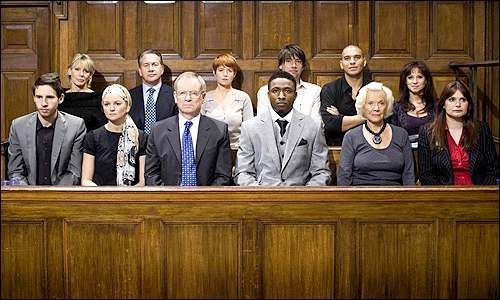
My firm’s latest Internet defamation trial in conservative Orange County provided some valuable insight into what goes through the jurors’ minds as they decide this type of case. (That's not the actual jury in the photo, but it pretty well captures the jurors' expressions throughout the trial.)
In this dispute, when an independent contractor’s annual contract was not renewed, she took to the Internet, posting defamatory comments about our client, the person she blamed for her termination. She apparently hoped to create enough controversy about our client that he would be removed, leaving her free to return to work under whomever took his position. All of her Internet postings were anonymous, with her creating different identities for the various postings, but we were able to determine her identity by means of a subpoena to the website operator.
After the jury found in our client’s favor, both in the trial and punitive damage phases, Defense counsel called for the jurors to be polled. This proved to be entertaining. As we later discovered when we spoke to the jurors following the punitive damages phase, most were in the middle of the damages range, but some wanted to award much more and one wanted to award little or nothing. They got nine jurors to the agree on the amount, but the other two ends of the spectrum took the opportunity of the polling to give a very emphatic "NO!" when asked if they had agreed to the dollar amount. One juror who had wanted to award more seemed especially upset.
The comments of the jurors following the action were very enlightening, and illustrate some of the issues that arise in any Internet defamation action. First there is the issue as to whether anyone actually saw the postings. Just because defamatory comments are posted on a given site does not mean that anyone read them. Thankfully, we had located a witness unrelated to the action who had seen the postings, so we were able to put a face on "Jane Internet Browser" for the jury so they would know that people actually saw the postings.
But that only leads to the second issue. Assuming the postings were seen, did they have any impact on the reputation of the Plaintiff? Our Jane Browser had never heard of the Plaintiff, and testified that she formed no opinion about Plaintiff good or bad after reading the postings. Indeed, that lack of an impact was only strengthened by our own parade of witnesses, all testifying that our client was a wonderful guy with a great reputation. That testimony was necessary in order to show the false and defamatory nature of the postings, but also served to support Defendant’s claim that despite her best efforts to harm Plaintiff’s reputation, she had not succeeded.
Then there is the issue of actual damages. Of course, general damages are presumed in a defamation action, but we prefer to show actual damages whenever possible to overcome the jury’s resistance to awarding damages when no quantifiable damages have been shown. It’s a little like asking a jury in a personal injury action to award damages for pain and suffering even though the victim had no visible injuries. In our business defamation cases we are almost always able to show actual damages by means of the loss of income to the business. Here, however, we took actual damages out of the special verdict because there was just no proof of any and an award by the jury would have been grounds for appeal.
Limited to presumed damages only, the jury gave a fairly modest award, but came back much bigger on the punitive damages. As suspected, the jurors said that they fought hard over the presumed damages because they did not get a sense that anyone thought less of the Plaintiff because of the postings. However, they had far less difficulty awarding the punitive damages because it was clear that the Defendant needed to be punished and deterred from engaging in the conduct in the future. The judge agreed, and added an injunction against defendant, prohibiting her from repeating the comments about Plaintiff. Indeed, he advised defense counsel (Defendant did not stay for the jury verdict) that Defendant would do well to cease all comments about Plaintiff.
-------------------------------------
August 2009
Communications Decency Act Still Unknown to Many Attorneys
It seems like every few weeks I have to rail against a lawsuit I read about, wherein the attorney representing the plaintiff brings an action that is clearly barred by the Communications Decency Act. In this latest installment, we find a New York attorney who represents plaintiffs who appear to have a solid case against some individual defendants resulting from some truly horrific defamation on the Internet.

But the attorney could not leave it alone. I can almost see his mind working. He thinks to himself, "these individuals will never be able to pay the judgment, so I'd better look around for some deep pockets." So, in addition to the individual defendants he names ning.com, wordpress.com, twitter.com, and my personal favorite, godaddy.com.
I sometimes use the analogy that naming a Internet Service Provider in an Internet defamation action is akin to naming Microsoft as a defendant because the defamer used Word to type the defamatory statements. I never thought any attorney would actually go that far, but the attorney in this case surpasses even that far flung analogy. I know it's a foreign concept to some attorneys and their clients, but a defendant should only be held liable for damages if he, she or it has done something wrong. Here, twitter.com is named because the defendants sent out "tweets" sending their followers to the defamatory content. Godaddy.com is named because the defendants obtained the domain name there, and then set it to forward to their blog on wordpress.com. How could these companies possibly be liable? Well, according to plaintiffs and their attorney, they are liable because what they defendants did amounted to an "irresponsible use of technology."
Apparently, in this attorney's world, we have gone beyond even requiring that the website provider check the content of every web page posted on its server. Now it is also the obligation of twitter.com to review and authorize every tweet that is sent, and godaddy.com must view with suspicion ever account that sets a domain name to forward elsewhere. Clearly there could be no Internet if such duty and liability could be imposed.
In (very slight) defense of the attorney, he does allege that these companies were informed of the nefarious use of their services, and did nothing to block the content. Among the public there is an urban legend that a company becomes liable once it is informed that it is being used to distribute the defamatory content, but an attorney should know better.
A copy of the complaint can be found here, and a detailed article about the case can be found here.
-------------------------------------
July 2009
More Judges Catching Up to the Times
Trials are decided by humans with all their human experiences. Whether a judge or jury is deciding your defamation case, your relative success will depend on the nature of those experiences, and your ability to persuade the trier of fact to set them aside when appropriate. Internet defamation cases necessarily require some understanding of the Internet by the trier of fact, or at least the willingness to absorb new concepts. Thankfully it has not happened to me in any of the cases I have handled, but I still hear horror stories about judges who make comments like, “no one really believes anything they read on this . . . In-ter-net,” or “what is this google you keep talking about?”
At least a Small Claims Judge in Canada appears to understand a thing or two about Internet defamation. In the case, the defendant took a disliking to a local dog kennel for whatever reason. She visited some animal discussion boards, and posted comments about the kennel, referring to it as a “puppy mill.” The kennel took exception to this characterization, and sued for defamation in Small Claims Court.
The court found in favor of the Plaintiff dog kennel, and awarded $14,000 in damages. The court correctly determined that calling a dog kennel a “puppy mill” is a bad thing. But what caught my eye was the simple logic of the judge, the sort of logic that sometimes alludes other judges. First he was upset that these postings were made on the Internet, recognizing that “the use of the Internet worsens the defamation.” That may seem extremely self-evident to most of us, but remember those aforesaid judges that still view that Internet as a fad among kids that will soon pass. The judge also stated that the defamation was “particularly malicious” because the purpose of the defendant was to put out of business a kennel that supported a family of 11.
Wow. A judge that recognizes that Internet defamation can be more egregious than verbal defamation, and who views the conduct from a real world perspective of how it impacts the people behind the business. Thank you Canada.
-------------------------------------
June 2009
Mistaken Reporting Does Not Amount to Actual Malice
A case indirectly involving Ozzy “Bark at the Moon” Osbourne affords me another opportunity to illustrate what a legal minefield a defamation case can present.

The case arose from statements made about Osbourne’s former physician, Dr. David Kipper. The New York Times published a story which included Osborne’s allegations that his former physician had over prescribed medication to him during his appearance on the MTV reality series “The Osbornes.” In that same article, the Times reported that the Medical Board had “moved to revoke” Dr. Kipper’s license.
The New York Post published a condensed version of the Time’s article, but during the summary process stated instead that the doctor’s license had been revoked. Under normal circumstances that would certainly constitute defamation, but let’s test your legal prowess. Do you see the problem? What if I tell you that Dr. Kipper is a public figure; now do you see the problem?
In order to prevail in his case against the Post, Kipper had to prove “[New York Times] actual malice.” He had the burden of showing that the Post had knowledge that the statement was false or made the statement with reckless disregard for whether it was true.
The Post brought a motion for summary judgment which was denied, but the appellate court reversed and ordered the case dismissed. The justice wrote, “Other than the fact that the rewrite contains erroneous statements, there is no evidence that anyone at the Post set out to falsely defame plaintiff in this instance, or other individuals regularly, to increase its sales.”
-------------------------------------
May 2009
Lawyers Still Treating Defamation Claims Like Any Other Tort

The raison d'être of the California Defamation Lawyers Association is to improve the representation of libel and slander clients through education and the open exchange of ideas. I received three reminders this week of the importance of the CDLA, all three of which confirmed that there are still a number of attorneys handling defamation actions without an understanding that defamation is not just another tort.
In the first instance, I read about an attorney in New York who brought action on behalf of a client for the comments posted on the defendant's website, even though those comments were posted on the public forum page by a third party. Let’s all say it together. If a website is created that allows visitors to post their comments, under the Communications Decency Act the host of that website cannot be held liable for any defamatory remarks that others post.
The law is very black and white in this area. The myth still continues among the public that if the defamed party makes the website operator aware of the defamatory material, he somehow becomes liable for failing to take it down. That is simply not true, and apparently many attorneys do not advise them otherwise.
There is a lot of abuse on the Internet, and ideally a web host should respond to requests to remove defamatory posts, but if that were made the law then the ability to host a community forum would disappear in almost all instances.
The second incident came in the form of a phone call. A potential client called to say that she had been defamed in a newspaper article, but she was looking for new counsel because it had been several months and her current attorney still had not filed an action. I asked if the current attorney had made the necessary demand for a correction, and she said no such demand was ever made. California Civil Code section 48a requires such a demand within 20 days or the plaintiff is limited to actual damages.
Finally, I was asked to consult on an Internet defamation case that has been pending for more than two years. The case had been dismissed by the trial court pursuant to an anti-SLAPP motion. The plaintiff's attorney did a brilliant job of obtaining a reversal by the Court of Appeal, and the plaintiff was hoping I would associate into the case now that the matter was back on the trial calendar. When I reviewed the case, I found that the complaint did not contain a cause of action or prayer for any equitable relief. Thus, there would be no mechanism for the court to order the defamatory statements to be removed, nor for an order that they not be repeated. The omission can be readily repaired by a motion to amend, but the complaint serves to provide another example of an attorney who was thinking strictly in terms of tort damages, not defamation remedies.
Sadly, this was not an atypical week. There is a real need for education in this area of the law, and through the activities of the CDLA we can hopefully be a part of that educational process.
-------------------------------------